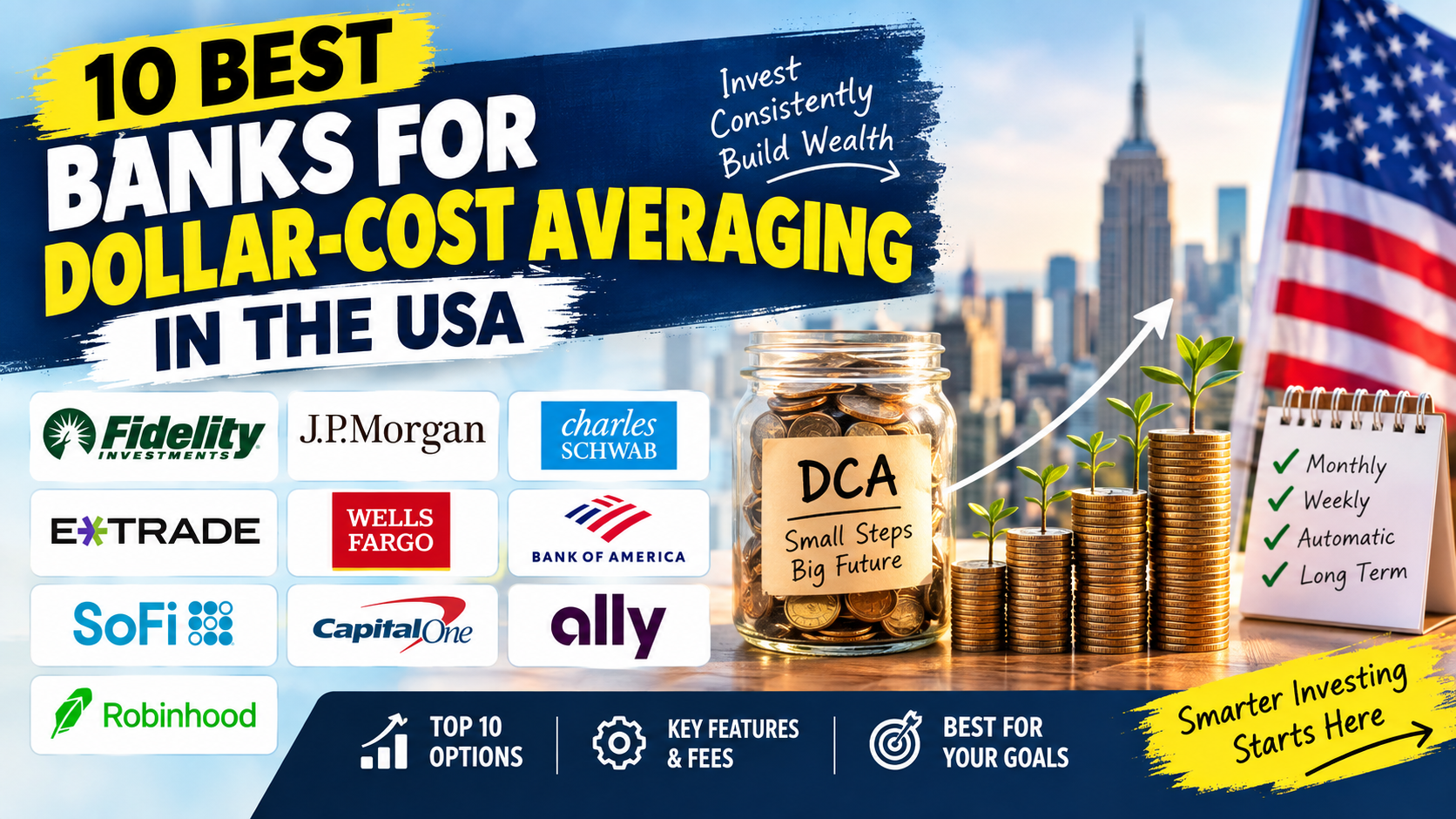
Dollar-cost averaging (DCA) is a simple investment strategy that can help people invest consistently without trying to predict the perfect time to enter the market. Instead of investing a large amount all at once, investors contribute a fixed amount at regular intervals, such as weekly or monthly.
For investors in the United States, choosing the right bank or investment platform can make automated investing easier. The best option depends on factors such as investment choices, fees, recurring investment features, account requirements, and overall convenience.
In this guide, we explore 10 popular U.S. banks and investment platforms for dollar-cost averaging.
What Is Dollar-Cost Averaging?
Dollar-cost averaging means investing a predetermined amount of money at regular intervals, regardless of whether the market is rising or falling.
For example, an investor could invest $200 every month into a diversified ETF. When prices are lower, the same $200 buys more shares. When prices are higher, it buys fewer shares.
The goal isn’t to predict market movements. Instead, DCA creates a consistent investing habit.
Important: Dollar-cost averaging doesn’t guarantee a profit or protect against losses. Investment values can rise or fall.
1. Fidelity
Fidelity Investments is one of the major investment platforms used by long-term investors.
Fidelity offers recurring investment functionality that can be used for eligible stocks, ETFs and mutual funds. This can make it convenient for investors who want to automate regular contributions.
Why consider Fidelity?
- Recurring investment options
- Wide range of investment choices
- No account minimum for many brokerage accounts
- Strong research and educational resources
- Suitable for long-term investors
2. J.P. Morgan
JPMorgan Chase offers both traditional banking and investment services.
Customers who already use Chase banking services may find it convenient to connect their banking and investment accounts and establish recurring investments.
Key features include:
- Banking and investing under one ecosystem
- Stocks and ETFs
- Mutual funds
- Automatic investing options
- Mobile banking and investing tools
3. Charles Schwab
Charles Schwab is another major choice for investors interested in long-term investing.
Schwab provides brokerage services alongside banking products, making it possible to manage multiple aspects of personal finance through one provider.
Potential advantages:
- Broad investment selection
- ETFs and stocks
- Brokerage accounts
- Banking services
- Investor education
4. E*TRADE
E*TRADE, part of Morgan Stanley, provides online brokerage services for investors.
It can be considered by people looking for a platform where they can manage investments while maintaining a regular contribution strategy.
Features to consider:
- Online brokerage
- Stocks and ETFs
- Mutual funds
- Retirement accounts
- Investment research
5. Wells Fargo and WellsTrade
Wells Fargo offers banking services while WellsTrade provides brokerage services.
This setup can be convenient for investors who already have a Wells Fargo banking relationship and want to connect their banking and investment activities.
Why investors may consider it:
- Banking and brokerage ecosystem
- Stocks and ETFs
- Mutual funds
- Retirement investing
- Online account management
6. Bank of America and Merrill
Bank of America and Merrill provide banking and investment services.
Investors who already bank with Bank of America may appreciate the integration between their banking and Merrill investment accounts.
Things to look at:
- Stocks and ETFs
- Mutual funds
- Retirement accounts
- Investment guidance
- Integration with Bank of America accounts
7. SoFi
SoFi has become popular among consumers looking for digital-first financial services.
Its platform combines banking, investing and other financial products, which can be useful for someone who wants to manage several financial activities through one app.
Potential benefits:
- Mobile-first experience
- Investment accounts
- Stocks and ETFs
- Automated investing options
- Banking services
8. Capital One
Capital One is primarily known for its banking and credit-card products rather than being a dedicated brokerage platform.
However, its banking products can be useful for creating an automated money-management system. Investors can use scheduled transfers to move money toward an investment account.
Best suited for:
- Automated savings
- Regular transfers
- Cash management
- Connecting banking with an external brokerage
9. Ally Bank
Ally Bank is another online banking option that can work well as part of an automated financial system.
Rather than viewing Ally solely as an investment platform, investors may use its banking services to automate transfers to a separate brokerage account.
Potential advantages include:
- Online banking
- Savings products
- Automated transfers
- No traditional branch requirement
- Integration with external financial accounts
10. Robinhood
Robinhood is a popular app-based investing platform.
Although it isn’t a traditional bank in the same sense as Chase or Bank of America, it is relevant when comparing automated investing options because investors can establish recurring investments in eligible securities.
Features to consider:
- Recurring investments
- Stocks
- ETFs
- Mobile investing
- Simple user interface
Comparison of DCA Options
| Platform | Banking | Investing | Recurring investing | Best suited for |
|---|---|---|---|---|
| Fidelity | Limited | ✅ | ✅ | Long-term investors |
| J.P. Morgan | ✅ | ✅ | ✅ | Banking + investing |
| Charles Schwab | ✅ | ✅ | ✅/available features vary | Long-term investors |
| E*TRADE | Limited | ✅ | ✅/available features vary | Online investors |
| Wells Fargo | ✅ | ✅ | Available features vary | Existing customers |
| Bank of America/Merrill | ✅ | ✅ | Available features vary | Bank customers |
| SoFi | ✅ | ✅ | ✅ | Digital-first users |
| Capital One | ✅ | Separate brokerage needed | Via transfers | Automated saving |
| Ally Bank | ✅ | Separate brokerage needed | Via transfers | Cash management |
| Robinhood | Financial services | ✅ | ✅ | App-based investing |
How Much Should You Invest With DCA?
There isn’t one universal amount that works for everyone.
Someone starting with a limited budget might choose $25, $50 or $100 per month, while another investor might contribute several hundred dollars monthly.
For example:
$100/month × 12 months = $1,200 per year
$500/month × 12 months = $6,000 per year
The important part is choosing an amount that fits your budget and financial goals rather than investing money you may need for essential expenses.
What Should You Invest in With DCA?
DCA can be used with different types of investments, depending on the platform and your strategy.
Common choices include:
- Broad-market ETFs
- S&P 500 index funds
- Total-market funds
- Individual stocks
- Mutual funds
- Other eligible securities
A diversified fund can provide exposure to many companies through a single investment, but diversification does not eliminate investment risk.
Bank vs. Brokerage: What’s the Difference?
One important point is that your bank doesn’t necessarily need to be your investment provider.
A common setup is:
Bank account → Automatic transfer → Brokerage account → Recurring investment
For example, you could keep your emergency savings at a bank while using a brokerage account for long-term investments.
This can give you more flexibility when selecting an investment platform.
Things to Check Before Choosing a DCA Platform
Before opening an account, compare:
1. Investment fees
Check commissions, advisory fees, expense ratios and other account costs.
2. Recurring investment features
Make sure the platform supports the type of recurring investment you actually want.
3. Investment selection
Check whether the platform offers the stocks, ETFs or funds you intend to buy.
4. Account minimums
Some products or managed services may require minimum deposits even when standard brokerage accounts don’t.
5. Fractional shares
Fractional investing can be useful when making smaller recurring contributions.
6. Automation
Look for automatic deposits and recurring purchases so you don’t have to manually place an order every month.
Is Dollar-Cost Averaging Good for Beginners?
DCA can be relatively easy to understand because it focuses on consistency rather than attempting to predict short-term market movements.
However, beginners should still understand the risks involved in investing. Markets can decline, and regular investing does not guarantee that an investment will increase in value.
Before investing, consider your:
- Financial goals
- Time horizon
- Risk tolerance
- Emergency savings
- Existing debt
- Investment costs
Frequently Asked Questions
What is the best bank for dollar-cost averaging?
There isn’t one universally best bank or platform. The appropriate choice depends on your investment needs, fees, available securities and desired automation features.
Can I automate $100 investments every month?
Many investment platforms offer recurring investment features, although available securities and minimums can differ by provider.
Is DCA better than investing a lump sum?
DCA and lump-sum investing have different characteristics. DCA spreads purchases over time, while lump-sum investing puts the money into the market sooner. The appropriate approach depends on the investor’s circumstances and objectives.
Can I use my regular bank account for DCA?
Yes. You can generally use a bank account to automatically transfer money to a brokerage account, subject to the providers’ account and transfer rules.
Is DCA risk-free?
No. DCA does not eliminate market risk. The investments you purchase can lose value.
Final Thoughts
Dollar-cost averaging can turn investing into a regular financial habit. For U.S. investors, platforms such as Fidelity, J.P. Morgan, Charles Schwab, E*TRADE, Wells Fargo/Merrill, SoFi and Robinhood provide various ways to manage recurring investments, while banks such as Capital One and Ally can be used to automate transfers into an investment account.
The right choice depends on fees, investment selection, automation, account requirements and your personal financial goals. Always review the current terms and fees before opening an account or investing.